
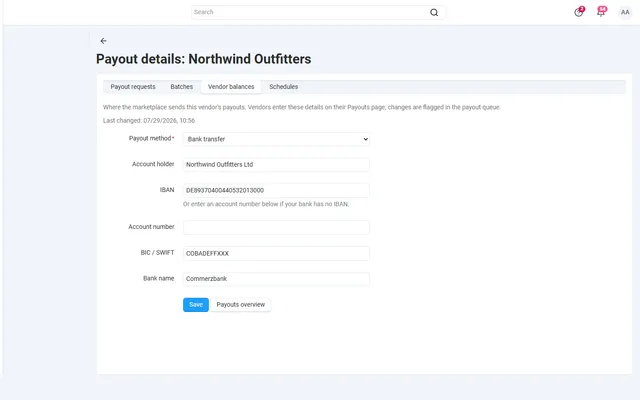
Vendor Payouts Automation
Payout schedules, hold periods, approval batches and SEPA or PayPal payout files, on top of core vendor accounting.
Platforms
 CS-CartAdd-ons and themes for CS-Cart and Multi-Vendor
 OpenCartExtensions and themes for OpenCart 4 and 3
 WooCommercePlugins and themes for WooCommerce
 PrestaShopModules and themes for PrestaShop 8.2 and 9
 ShopifyBuilt for every Shopify plan, billed by Shopify
Stores
CS-Cart guide · SEO Pro Suite
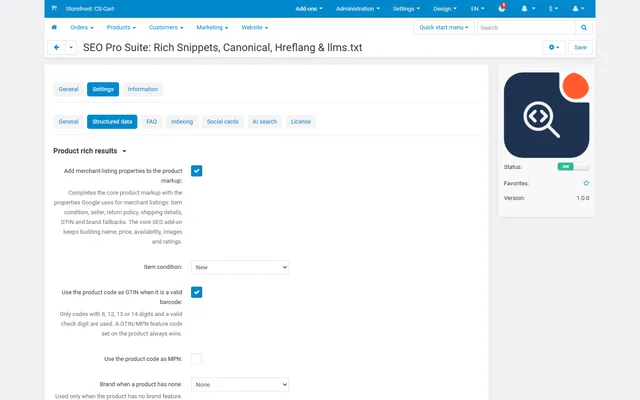
SEO Pro Suite completes the product markup of the core SEO add-on with shipping and return details, adds FAQs, robots rules for sorted and search pages, complete social cards and a generated llms.txt. One Product block, never two.
The problem
The core SEO add-on gives you friendly URLs and basic markup. Rich product results now look for shipping details, return policies and GTINs, and sorted or search pages waste crawl budget.
Adding another SEO add-on on top often prints a second Product block, which confuses search engines more than it helps.
SEO Pro Suite: Rich Snippets, Canonical, Hreflang & llms.txt
Review the settings; the storefront prints the extra tags at once, in the same place as the core markup.
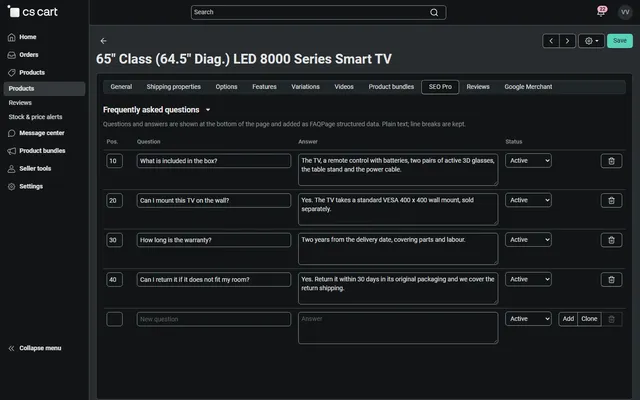
Add questions on the SEO Pro tab of a product, category or page. They show as an accordion and as FAQ data.
On Website > SEO Pro Suite, check any page, see catalog gaps, write AI crawler rules to robots.txt and preview llms.txt.
Item condition, seller, return policy, shipping details and price validity.
GTIN from barcode-like product codes, brand fallbacks and a coverage report.
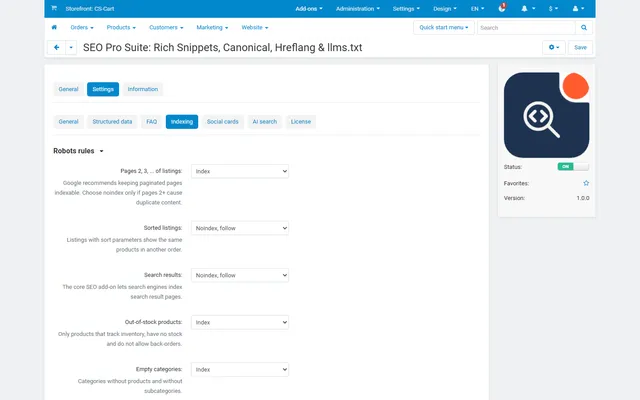
For paginated, sorted, search, out-of-stock, empty and vendor pages, with overrides per product, category and page.
Canonical links where the core has none, removed from noindex pages; hreflang region codes and x-default.
Open Graph and Twitter cards with product price and availability.
A generated llms.txt and an AI crawler policy for robots.txt.
SEO Pro Suite: Rich Snippets, Canonical, Hreflang & llms.txt
The bundled SEO add-on handles friendly URLs and a basic Product item. Since 4.21 core also prints BreadcrumbList and an Organization item. That is a good base, but Google’s merchant listings ask for more: condition, seller, return policy, shipping details and identifiers such as GTIN. Sorted listings and search results stay indexable, and social cards are incomplete.
SEO Pro Suite extends the core output instead of duplicating it. It completes the existing Product block, so there is never a second one, and adds its own items in the same JSON-LD loop. Everything below is optional per setting.
| Page | Structured data from the add-on |
|---|---|
| Home | WebSite; Organization before 4.21, or the missing fields of the core item on 4.21 |
| Product | Condition, seller, return policy, shipping, price validity, GTIN, MPN and brand fallbacks; FAQPage if it has FAQs |
| Category | FAQPage if it has FAQs |
| Information page | FAQPage if it has FAQs; canonical link |
| Blog post | BlogPosting; canonical link |
| Vendor page | OnlineStore; canonical link |
| Pages with breadcrumbs | BreadcrumbList before 4.21 only; from 4.21 core prints it |
Every page also gets a robots tag and Open Graph and Twitter card tags. Product pages add price, availability, condition and item ID. Nothing depends on the visitor, so pages stay cacheable.
The page check on Website, SEO Pro Suite tests any URL for required and recommended properties, and shows catalog gaps such as missing GTINs, brands and descriptions.
| Rule | Default | Why |
|---|---|---|
| Pages 2, 3 of listings | Index | Google recommends keeping pagination indexable. |
| Sorted listings | Noindex, follow | Same products, new URL. |
| Search results | Noindex, follow | Core lets them be indexed. |
| Out-of-stock products | Index | Only tracked products with no back-orders are affected if changed. |
| Empty categories | Index | Your call per store. |
| Canonical on pages with none | On | Information and vendor pages. |
| Canonical on noindex pages | Removed | Avoids mixed signals. |
Each product, category and page has a Robots override on its SEO Pro tab. The add-on never prints a second robots tag on pages core already marks noindex, such as filtered listings, cart, checkout and account pages.
For hreflang, keep the core output, apply custom codes per language such as en=en-US and fr=fr-CA, leave a language out, or set x-default. Removing hreflang altogether is also an option.
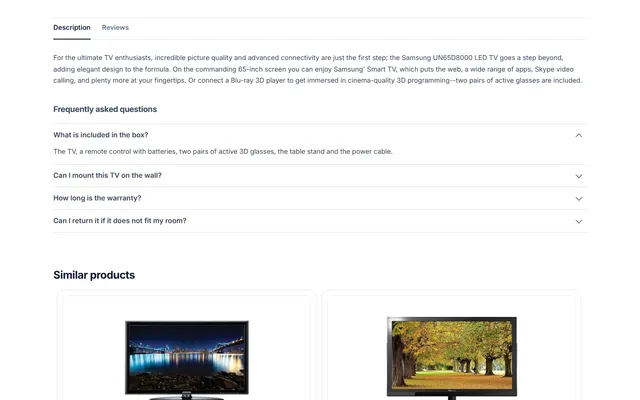
The SEO Pro tab on products, categories and pages holds questions and answers. They show as an accordion that works without JavaScript, and print as FAQPage data with the same text. On Multi-Vendor, vendors can edit FAQs on their own products.
Google shows FAQ rich results only for a small set of authoritative sites. The FAQ is still useful for buyers on the page and for AI assistants that read it, but do not buy this add-on expecting FAQ snippets in Google.
llms.txt is a proposed standard: a Markdown file at /llms.txt that summarises a site for AI assistants. The add-on generates it from your catalog: store summary, popular products up to 500, prices, categories, pages and blog posts. On 4.21 plans with the core llms.txt editor, text you enter there is served instead.
For AI crawlers, you pick a policy: allow all, block training but allow AI search, or block all. The rules are written to robots.txt only when you click Write to robots.txt. robots.txt is a request that reputable crawlers follow, not access control. To actively stop scrapers, use Bot & Country Blocker.
It does not write titles or descriptions: SEO Meta Templates fills empty ones from templates. It does not create landing pages: SEO Filter Landing Pages turns category and filter combinations into indexable pages. It does not fix broken URLs: 404 Monitor & Redirect Manager handles those. It also cannot promise rankings or rich results, since Google decides what it shows.
| Core SEO add-on | Hand-edited templates | This add-on | |
|---|---|---|---|
| Friendly URLs | Yes | Core | Core |
| Merchant listing properties | Basic | If maintained | Yes |
| Survives core upgrades | Yes | At risk | Yes, no core edits |
| Second Product block risk | No | Yes | No |
| llms.txt and AI crawler rules | 4.21 editor on some plans | No | Yes |
The catalog and SEO add-ons page lists the rest. Get SEO Pro Suite on the store.
CS-Cart and Multi-Vendor 4.17.2 to 4.22.x, PHP 7.4 to 8.3 as your version supports, with the core SEO add-on active, as it is by default. On Ultimate, every storefront has its own values. Full page cache is supported, and the add-on adapts to 4.21, where core prints its own breadcrumb and Organization items.
CS-Cart
Complete rich results, robots and canonical rules, social cards, FAQs and AI search files on top of the CS-Cart SEO add-on.
CS-Cart
The most requested products on this platform. Each one has its own page, and you can buy it straight on the sales site.
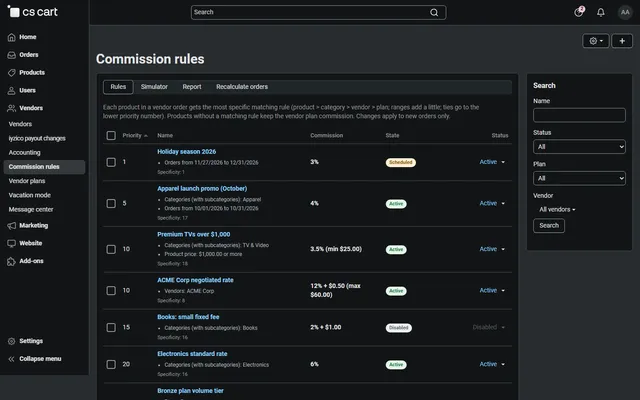
Payout schedules, hold periods, approval batches and SEPA or PayPal payout files, on top of core vendor accounting.
Commission by vendor, category, product, price or monthly sales on top of your vendor plans, with a simulator.
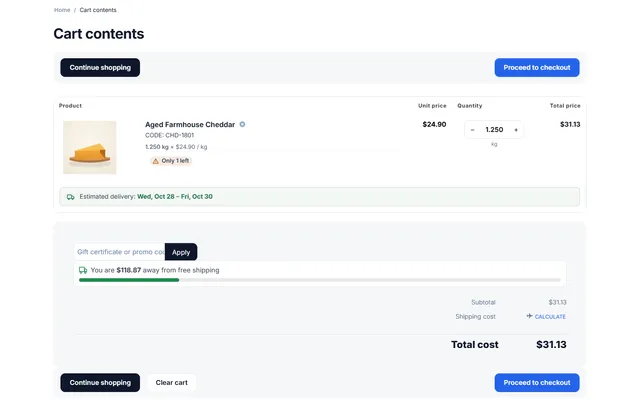
Decimal quantities with a unit, step, presets and price per kg or metre, with exact stock down to 0.001.
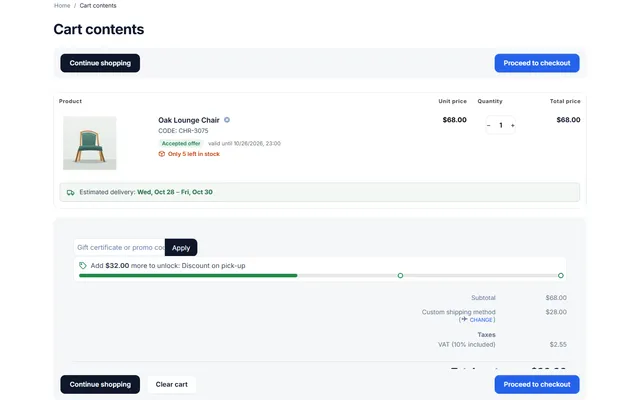
A Make an offer button with counter-offers, deadlines and a single-use agreed price; vendors answer their own offers.
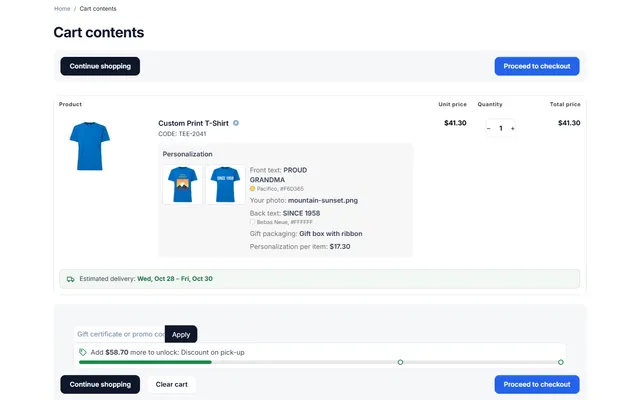
Text, photo and choice fields on print areas with a live preview, server-rendered proofs and surcharges.
XRechnung, Factur-X/ZUGFeRD and Peppol BIS 3.0 e-invoices and credit notes from every order.
Prices, licences, full documentation and instant downloads are on the store.
cs-cart.kaviolabs.com · 245 add-ons · 47 themes
FAQ
No. It completes the product markup of the core SEO add-on and adds its own items in the same place, so there is never a second Product block.
CS-Cart and Multi-Vendor 4.17.2 to 4.22.x, with Ultimate storefront settings and full page cache support.
Yes. On Multi-Vendor, vendors edit the FAQ of their own products.
No tool can. It makes products eligible by adding the properties Google documents; whether rich results show is up to the search engine.
No. It needs the core SEO add-on active, and completes its output.
Merchant listing properties on products, address and contact point on the Organization, and FAQPage, WebSite, BlogPosting and OnlineStore items. It does not print a second breadcrumb or organization block.
A product feature with the code GTIN or MPN wins. Otherwise a barcode-like product code with a valid check digit is used as GTIN, and a fallback can set the brand to the storefront or vendor name.
Google shows them only for a small set of authoritative sites. The FAQ still helps buyers on the page and is read by AI assistants.
It is your choice. Blocking training while allowing AI search keeps you visible in tools that link to your store. robots.txt is a request, not access control.
The product page has the full documentation, screenshots and the changelog.
Kavio Labs
The same standards, the same support desk and one licence portal on every platform we build for.